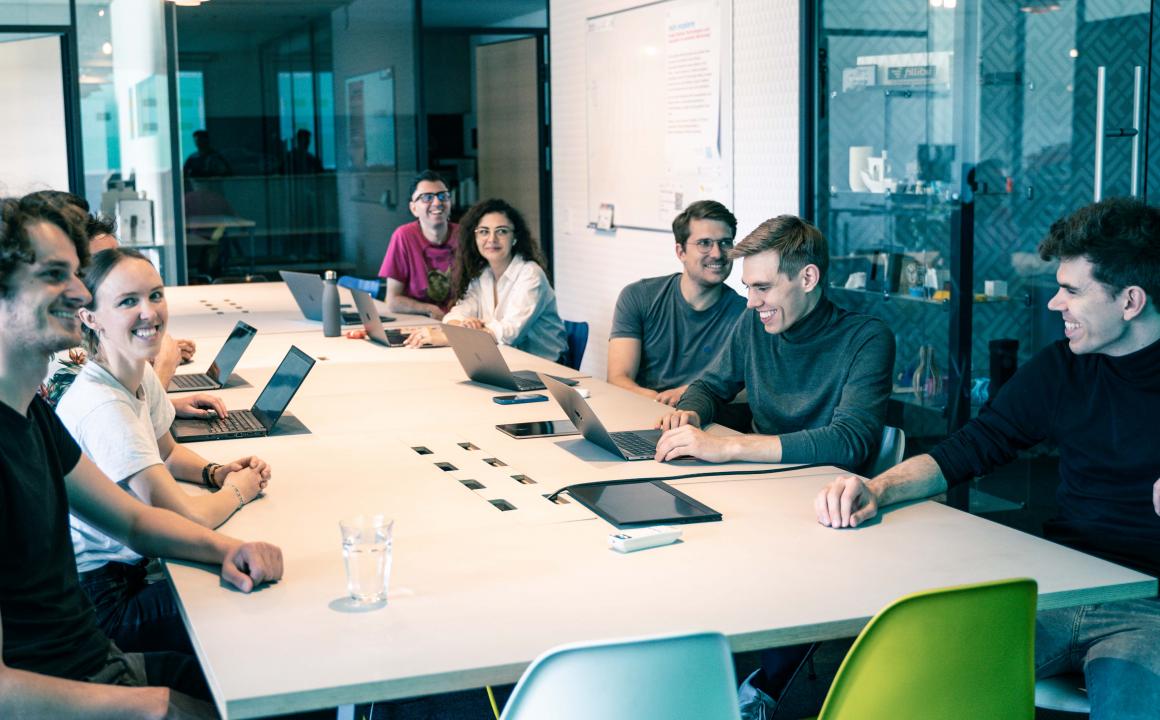
Founded in 2022, the startup RIZM helps companies optimize their energy infrastructure. In this interview, Joshua Küpper, founder of RIZM, explains how the collaboration with BMW began and how it has contributed to the development of the startup.
Joshua, thank you for taking the time for this interview. Can you tell us a little about your background and the founding of RIZM?
I am one of the three founders of RIZM, formerly known as Kerith. My professional background is in actuarial science and risk management. My two co-founders, Elias and Philipp, have different but complementary backgrounds. Elias has worked extensively with energy systems and conducted research at Stanford University on how to optimize them using algorithms. Philipp is also an engineer specializing in energy systems. The idea to found RIZM came when Elias returned to Germany after his time at Stanford. He had gained valuable insights from his research that could be of enormous importance to the industry.
Initially, we considered establishing a consulting firm to assist governments and industries with energy optimization. However, it proved challenging for a young company to gain a foothold in this field. Therefore, we decided to focus on developing a software platform that helps companies use energy more efficiently while achieving their climate goals.
The idea to found RIZM came when Elias returned to Germany after his time at Stanford. He had gained great insights from his research, which we quickly realized could be of enormous importance to the industry.
You originally started out as a consulting firm. How did you evolve into a software company?
We initially offered consulting services as a GbR (civil law partnership). We quickly realized that our algorithms and methods worked in practice and could offer companies real added value. The gas crisis was a catalyst for us. Many companies were looking for alternatives to gas and suddenly became very interested in our solutions. That's when we realized we had to change our business model. We developed software that enables companies to reduce their energy costs while achieving their climate targets.
When did you achieve your breakthrough?
A significant breakthrough was our collaboration with BMW. We were able to use our algorithms to help them achieve their climate goals more cost-effectively. In doing so, we achieved savings in the high triple-digit millions, which was of course enormous. This success opened many doors for us and led to further partnerships, especially in the automotive sector. That was a real milestone for us.
After our initial successes, especially our collaboration with large companies such as BMW, we decided to raise capital to accelerate our growth. In 2023, we completed a fundraising round with Point Nine and Early Bird and converted our company form a GbR (civil law partnership) to a GmbH (limited liability company) in order to present a more professional image. Our headquarter remained in Münster, but we work in a highly decentralized manner and continue to use coworking spaces. This flexibility is a great advantage for us, as it allows us to respond more quickly to changes.
So you've chosen a remote-first approach. How do you organize your team and what challenges does that bring?
Our team has now grown to 15 people, with the majority working in software engineering and customer success. We are indeed remote-first, which means that our employees work from different cities such as Münster, Munich, and other locations. This decentralized way of working gives us a great deal of flexibility, but it also presents us with challenges, especially in terms of communication and team cohesion. To counteract this, we regularly use virtual meetings and project management tools.
You decided to apply for the Digital Hub münsterLAND accelerator program. Can you tell us more about that?
Yes, that was a conscious decision on our part. We were originally looking for a coworking space and then became aware of the ecosystem and the accelerator. After applying and being accepted into the program, we were able to benefit not only from coaching and mentoring, but also from contacts such as BASF, DMG Mori, and other interesting companies. That gave us a real boost.
How has the Digital Hub affected your work and team structure?
Very positively. The Hub not only provides a physical space for meetings and collaboration, but also an opportunity to expand our network. At the Hub, we often meet other startups and companies with whom we can exchange ideas and learn from. This has led to many new ideas and collaborations.
At the same time, we see that the team uses the Hub as a welcome change from working from home and appreciates the opportunity to meet in person on a regular basis.
At the hub, we often met other startups and companies with whom we could exchange ideas and learn from. This led to many new ideas and collaborations.
Back to your software solution: What are the main functions of the platform, and how do customers benefit from it?
Our platform is designed to help companies optimize their energy costs while achieving their climate goals. Essentially, it's about being able to make all energy-related decisions using the software. This means that companies are able to monitor their energy consumption, reduce costs, and increase the efficiency of their energy systems. Our algorithms continuously analyze the data and provide recommendations for action.
We developed software that enables companies to reduce their energy costs while achieving their climate goals.
So you aim to support companies in operating more sustainably. What are your plans for the future?
Absolutely, sustainability is our focus. In the future, we want to further develop our platform and add new features that give our customers even more control and transparency over their energy systems. We also plan to expand into other industries and grow our international activities. We see great potential in offering our solutions in other markets as well - especially in countries that also face major challenges in the areas of energy efficiency and climate protection.
What motivates you as a founding team, and how do you maintain the entrepreneurial spirit within the team?
What drives us is the vision of making a real difference - both for our customers and for the environment. We see our work as contributing to the energy transition and creating a more sustainable future. This idea motivates us every day. To foster entrepreneurial spirit within the team, we rely on open communication, flat hierarchies, and the opportunity for everyone to contribute their own ideas and take on responsibility. This helps us to remain innovative and keep motivation high.
One last question: What has been the biggest challenge for you as founders so far, and how did you overcome it?
The biggest challenge was definitely the transition from a consulting firm to a software solution. It wasn't easy to change the business model and gain the trust of our customers at the same time. We invested a lot of time and energy to ensure that our software actually delivered the added value we promised. Looking back, this decision was absolutely the right one, and the positive feedback from our customers shows us that we are on the right track. The success with BMW was, of course, a huge motivational boost that showed us that we are on the right track with our strategy.