planbar is a digital planning board for craft businesses that enables companies to coordinate their staff, machines, and orders easily and clearly, with very little time required for setup.
Hi, it's great to see you again! Tell us a little about yourselves: who are you, what do you do, and what drives you?
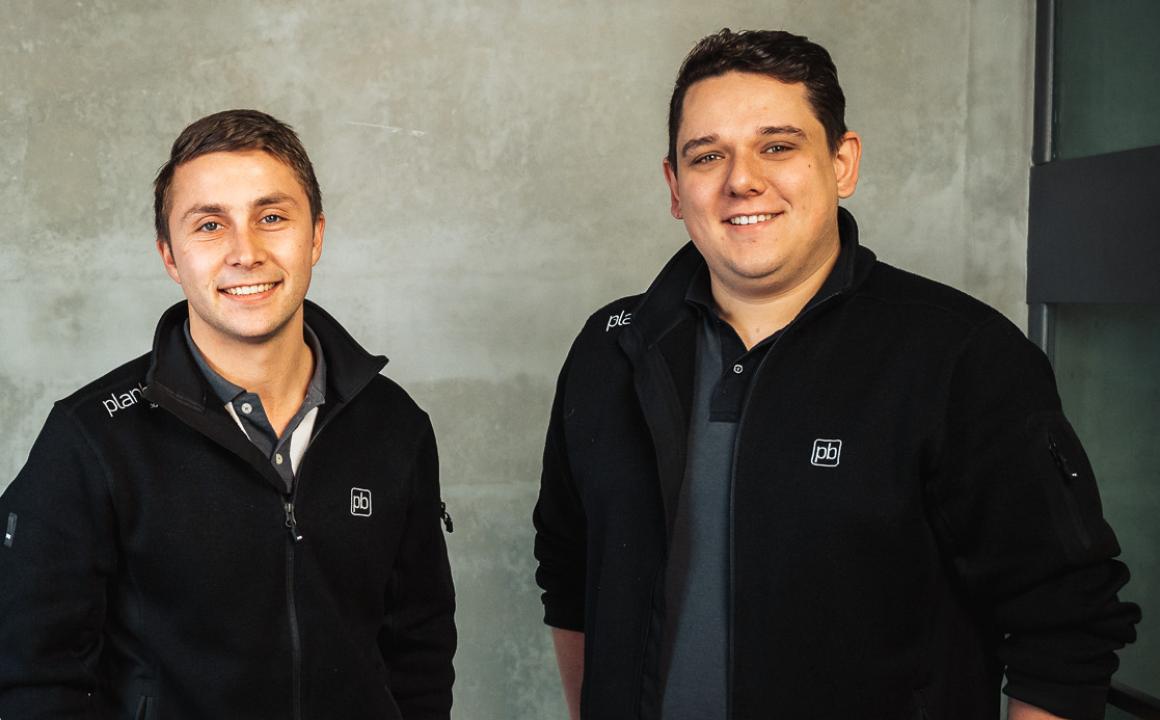
Martin: I'm Martin Steib, originally from Bocholt, spent 10 years in southern Germany, trained as an IT specialist, and have known David for 25 years now. David came to me with the idea at some point, then we discussed it and got to work, and that ultimately led to our collaboration and the start-up. What drives us is realizing our own idea, creating added value for society, and the product.
David: Then I'm the counterpart; David Zimmermann, now 31 years old, trained master gardener. Originally, I didn't have much to do with IT and technology and took the traditional route of vocational training. Then I gained experience in Switzerland, among other places, and became a master gardener. After that, I joined a landscaping company. In the beginning, we had a decentralized office and quickly realized that we were encountering some technical hurdles.
Our principle is that there must be a solution for every problem, and that's exactly where Martin came in. At work, we lacked an overview of where our employees were, how we could allocate them sensibly, and how we should respond to daily changes such as illnesses and material shortages. These are typical difficulties faced by a craft business. After searching for a solution and finding nothing, the idea for planbar was born.
It was inconceivable to us that there was no solution, because we thought that every other business must have a similar problem.
These are typical difficulties faced by craft businesses. After searching for a solution and finding nothing, the idea for planbar was born.
What is planbar in three sentences?
David: Planbar is a digital planning board that allows you to plan your orders and employees. Employees receive the information on the planning board on their cell phones, where they can access the construction site file and record their hours, for example. At the end, the data is transferred back. Basically, it is a tool for managing a skilled trade business.
Who are planbar's typical customers?
Martin: Of course, they primarily come from the skilled trades. These are businesses ranging from one person to currently 70.
David: As a rule, it is the traditional businesses that send their employees out to work for customers who can use this type of employee scheduling and who are dependent on the transfer of data, e.g., painters, roofers, carpenters, and gardeners.
You come from a horticultural background yourselves, so you are experts in the craft industry. That means you have a very good understanding of the problem you are solving. But then you joined the Digital Hub münsterLAND accelerator program. What were your hopes for this, and how did you succeed?
David: Basically, we wanted to move forward with our product and needed helpful tips, the network, and the experience behind it. Of course, we didn't want to make the mistakes that others had already made. Through the Digital Hub, we met people with whom we are still in contact today and with whom we have a very close relationship. We really liked that.
Martin: One of our advisory board members, for example, is from the Hub network.
David: A huge added value was that, with the help of the Hub, we learned to approach some things in a more structured and targeted way. Often, you're so busy “doing and making” that you become a little blind to what's going on around you. So it's helpful when someone from outside looks at things and gives you pointers in certain areas, and you realize: Ah, that's better after all!
Martin: We also benefited greatly from the Hub's knowledge of the various methods of scaling. Unlike traditional landscaping companies, which are set up for many decades, we as startups are dependent on the growth of the business.
You just mentioned it briefly—you were also in contact with Kurt Trautmann, an expert from our network. How did this collaboration come about, and what did it achieve?
David: We first met Kurt Trautmann in one of the expert panels, where you can ask the experts about pressing issues. We quickly hit it off and learned a lot from Kurt. Our contact then intensified until he became a highly valued member of our advisory board.
We quickly hit it off and learned a lot from Kurt. Our contact then intensified until he became a highly valued member of our advisory board.
Since a lot has surely happened since you participated in Accelerator 2021, I'm interested in what that was and where you currently stand.
Martin: A lot has happened. We expanded our team to include a CTO, whom we also met through the hub. At the end of last year, there were four of us; now there are 12 in total. We moved offices and feel like we have to reinvent and reorganize ourselves on a monthly basis because the size of the team is constantly changing and growing.
David: Another big step for us was that we were looking for investors at the time of Demodays, and we have now found them and collected our first investment, which will enable us to continue growing.
Congratulations! How did you go about finding investors? Or did they find you?
David: We tried to involve and activate all of our contacts, and then, of course, we practiced our pitch over and over again and polished our presentation until we were able to present it in a much more professional manner. Ultimately, we found a group of investors from Düsseldorf who were very interested in us and, in particular, the story we tell – “From craftsmanship for craftsmanship.” Then it was time for negotiations. Here, too, we were able to fall back on the help of the hub from time to time and reached an agreement with the investors last fall.
What are the top three lessons you would share with other founders who are also seeking investment?
David: Start early, pursue at least two avenues simultaneously, and make your first move with your own term sheet.
David: Take care of things in good time, pursue at least two avenues, and make your first move with your own term sheet.
Thanks, that's very helpful! How much money are we talking about? How do you plan to use the investment?
David: A small to medium six-figure sum. We'll use it to ramp up our development capacities and marketing. In terms of developers, we've grown from one full-time developer to a total of seven developers, i.e. Arne plus six working students. In addition to increasing our marketing budget, we'll also be increasing our sales and support spending slightly, because we've learned that tradespeople are very service-oriented.
Can you elaborate on that?
Martin: We have to offer a certain level of availability. If a tradesperson is in a bad mood because something isn't working, they want to be able to call somewhere and say, "This isn't working!
It doesn't work like many other large digital services that don't offer a hotline. We can't do that because tradespeople in German-speaking countries expect a minimum level of service and want to be guided a little.
Martin: We have to offer a certain level of availability. If the repairman is in a bad mood because something isn't working, he wants to be able to call somewhere and say, “This isn't working!”
Looking ahead, what's next for you?
David: Communication in particular will become increasingly important for us and the product in the future. This is because tradespeople are skilled at their craft, but sometimes still struggle when it comes to communication. This applies, for example, to communication between the company and its employees, between the company and its customers, or even between third-party companies and subcontractors. Here, too, we want to simplify things for tradespeople, ultimately helping them to create added value for their customers.
Are you currently only operating in the Münsterland region, or have you already expanded beyond that?
David: We have customers throughout the entire DACH region. Of course, the region is more strongly represented locally, simply because the network is there, but basically, companies from all over the German-speaking world contact us and ultimately use planbar.
Is there anything else you would like to say to the Hub community?
Martin: We hope that more people will have the courage to start a startup and find their way to the Hub. We are extremely grateful for all the support and the stimulating and critical discussions.
We hope that more people will have the courage to start a startup and also find their way to the hub.