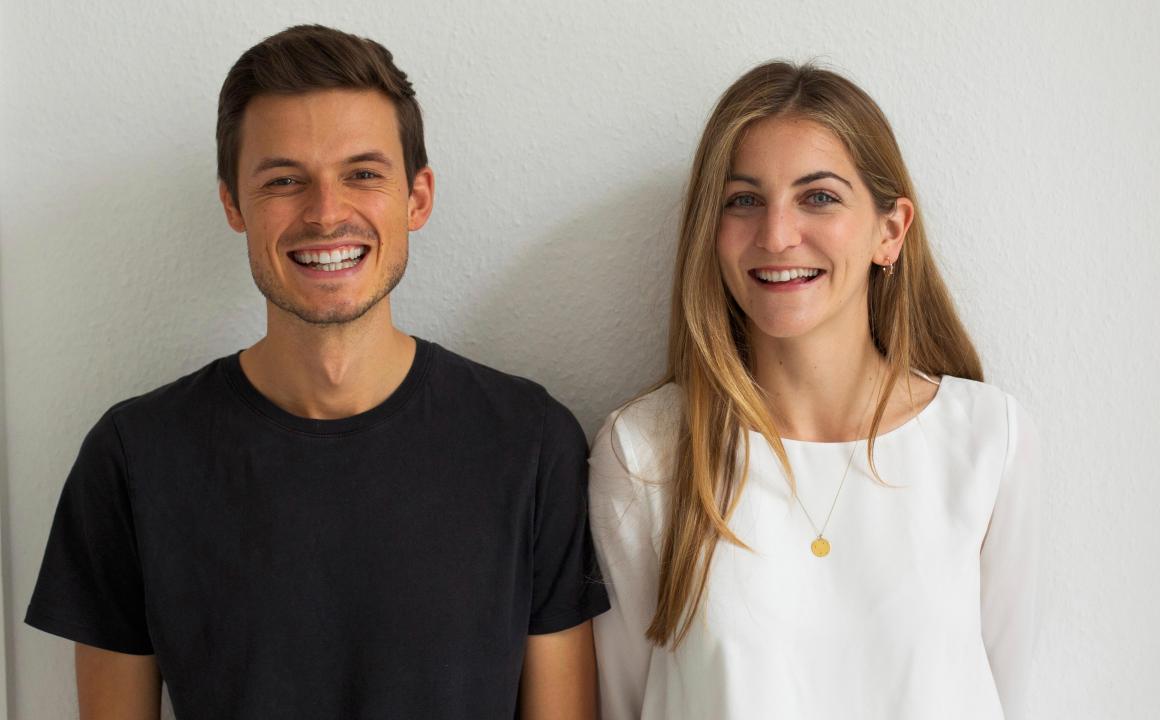
Our project manager Linda Witzel and board member Sebastian Köffer talk to Evermood co-founder Marvin, who recounts the journey from an accelerator startup in Münsterland to a successful company with an even bigger vision.
Evermood offers a work-life platform for companies to provide their teams with GDPR-compliant virtual live events, helpful exercises, and confidential one-on-one consultations in just a few clicks, as well as insightful reports on the culture and health of their organization. Based in Münsterland, the team has grown significantly in recent years and, after working in Münster and Bielefeld, is now based in Berlin. Co-founder Marvin explains what helped them along the way in this interview.
Linda: Where are you right now and what is important for Evermood at the moment?
Marvin: We have now grown to 20 people and, of course, we also had to cope with the coronavirus situation. This includes challenges such as how to expand the team and how to adapt our business model to the new working environment. We have now found a model that we believe fits the requirements of the market. At the moment, it is particularly important for us to grow our team steadily and organically while keeping an eye on our liquidity to ensure a sufficiently high run rate.
Sebastian: Can you briefly explain the main difference between your current product and the one you had back in Münster?
Marvin: In the beginning, we had an anonymous and discreet chat service that allowed employees to get help from contact persons with critical questions at work. We have since expanded our product and business model and now offer virtual live events, helpful exercises, and confidential one-on-one consultations on a flat-rate and on-demand basis.
Linda: What thoughts still connect you to your start-up phase in Münster today?
Marvin: On the one hand, Münster was our bachelor's degree city. Here, we were given many tools that help us to keep an eye on the management of Evermood today. On the other hand, in contrast to the rigid construct of “studying,” we were able to move and develop much more freely in the startup and discovered completely new strengths here.
Sebastian: Do you still recruit people from Münster, or did people from Münster move to Berlin with you back then?
Marvin: Yes! Our first employee came with us from Münster to Bielefeld and then on to Berlin. We then found two more people in Bielefeld and took them with us to Berlin as well.
Linda: In Münster, you started development work with the company Zweitag early on. How did this happen and what effect did it have?
Marvin: We got to know Zweitag at one of their events. Julian Schneider, the CEO of Zweitag, had a positive impression of our vision and found us interesting as a team. Based on this, he set up an investment structure, which we also found exciting. We still have a very close sparring relationship today.
Julian Schneider, the CEO of Zweitag, had a positive impression of our vision and found us as a team interesting. It was precisely on this basis that he then set up an investment structure, which we also found exciting. We still have a very close sparring relationship today.
The collaboration came about because we needed specialist resources at the time. At such an early stage, with a product that touches on so many sensitive areas such as data protection, it was very important for us to have a competent partner like Zweitag at our side.
Linda: Your next step was the Founders Foundation in Bielefeld. How did they help you on your journey?
Marvin: In Bielefeld, we once again received intensive sparring, coaching, and feedback, almost like in a boot camp. But having this reality check so clearly in front of us was very important and helped us as first-time founders to take off our rose-colored glasses. In addition, a lot was done there for our own public image, so that we could actively exchange ideas with companies.
Linda: How do you ensure that the employees of the companies you sell your product to also use your platform regularly? How were you able to ensure that it would work, especially in the beginning?
Marvin: That was one of the biggest challenges for us last year. How can we ensure that our customers not only stay under contract for one year, but also go into the second or third year? The biggest challenge is to make communication as efficient as possible, but also to spread it widely.
The biggest challenge is to make communication as efficient as possible, but also to disseminate it widely.
To achieve this, we provide our customers with newsletters and other digital formats that they can share via their intranet or directly with their employees. This means that on various days, such as Diversity Day or International Women's Day, we send different communication materials to the human resources or health departments of companies, who then forward them to their organization and draw attention to our product.
Linda: You just mentioned that you are based in Berlin. What was the deciding factor in moving to the capital? And was that your master plan from the beginning?
Marvin: I think my master plan would still be New York or San Francisco (laughs), but you have to be realistic, especially with the business model we have, so we're focusing on the DACH region and Europe. We went to Berlin because we were able to win one of our first customers there, Deutsche Bahn. That was great because we learned a lot and it took a long time. On the other hand, in the “pre-corona era,” we looked at where we could find the largest network for exchange: at that time, it was still limited in Münster, relatively good in Bielefeld, and a completely different universe in Berlin. Here, I can reach any major VC in Europe that I want to talk to in five to ten minutes by public transportation. Then Corona came and it didn't really matter to be in Berlin. What was also important about Berlin at the time, however, was sourcing developers, which has now become relatively irrelevant because, with a remote-first culture, we work a lot from home or from Cape Town, Bali, or similar beautiful work/vacation locations.
You have an idea, but you need an incredible amount of feedback, and Münster is a great place to get that efficiently. I think Münster is a fantastic test market for getting transparent feedback quickly, whether it's a B2B or B2C product.
That's why I would say now that we probably wouldn't have chosen Berlin under the circumstances of the coronavirus pandemic.
Linda: What is your most important tip for startups in the Münsterland region?
Marvin: Use the promenade as much as possible by bike (laughs) to reach as many customers as possible. Of course, things are a little different due to the coronavirus pandemic, but you can almost always make a video call. Since Münster is so small, you can quickly get to your customers and exchange ideas, which I think is the most important thing. You have an idea, but you need an incredible amount of feedback, and you can get that really well and efficiently in Münster. I think Münster is a fantastic test market for getting transparent feedback quickly, whether it's a B2B or B2C product.