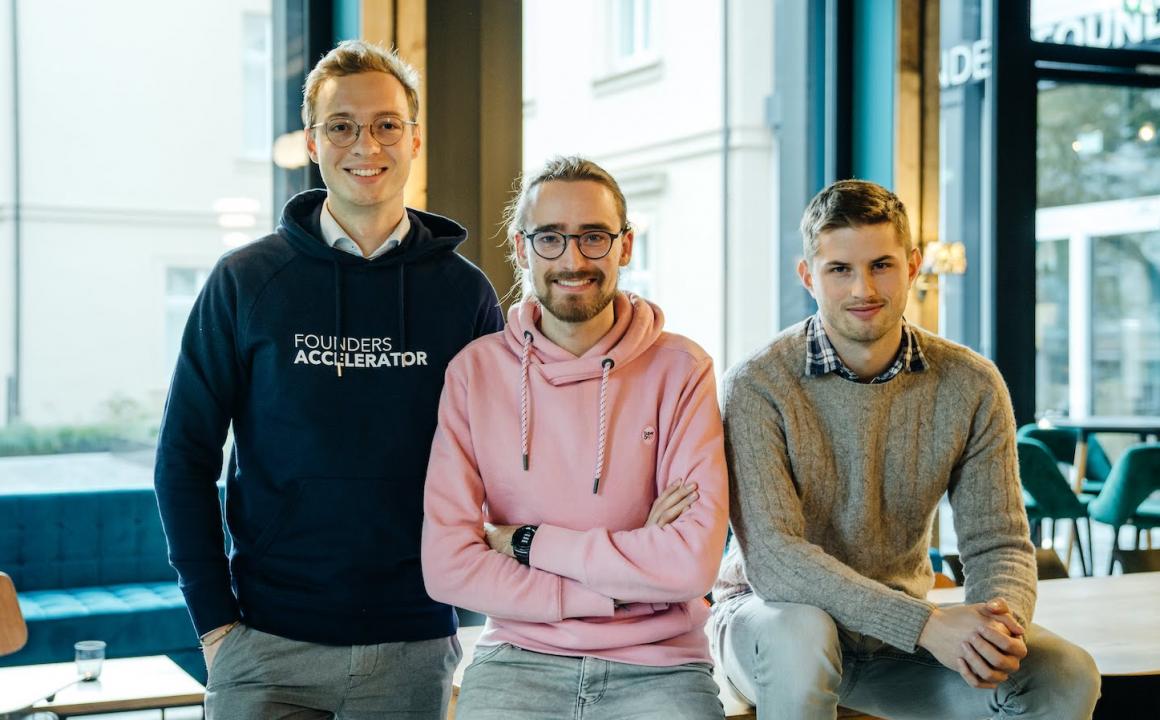
Echometer offers companies a SaaS solution that supports agile working methods in teams and makes team development in companies measurable. The three founders have now completed their first seed investment of EUR 600,000.
In 2019, Echometer completed the Digital Hub Accelerator program. Shortly after the seed deal, Echometer founder Jean Michel Diaz sat down for an interview with our Entrepreneur in Residence Simon Janssen.
Before we talk about the €600,000 seed investment, tell us briefly in a few sentences who you are and what Echometer does.
We develop software for companies that helps them establish agile working methods in teams and make team development measurable. We originally started in 2016 with the idea that people in Germany should focus more on corporate culture. We were still students at the time. Back then, we mainly looked at what other startups in the US and Canada were doing that had achieved a certain level of scale in the area of corporate culture. So we started out relatively bluntly by digitizing employee surveys and taking advantage of the benefits of digitizing employee surveys. That was also what we pitched at the Founders Foundation in Bielefeld as a first step, and it was very well received by the audience. Fortunately, this gave us a real boost when we realized, “Hey, this is actually an issue!” Over time, our software has developed into a very cutting-edge product. With Echometer, we no longer target every company, but rather those companies that are committed to agile working methods. In other words, fast, iterative work with flat hierarchies and teams that have a lot of autonomy.
It's been a very long journey from 2016 to where we are today. How big was the team when you started, and where are you now?
One of the most important factors from the outset was that we had a very diverse team, with Christian as a psychologist, Robin as a software developer, and me as a business economist. This meant that we didn't need a larger team at such an early stage, when we didn't yet know exactly where the journey would take us. In my opinion, it's a big mistake to start with a large founding team right from the beginning, as this takes away the necessary flexibility. We have now reached a stage where we know which direction we are heading in for the future. Our team currently consists of five full-time employees and a number of working students and interns. With the financing round, the team will now grow even further.
That's the key point! How much money did you raise in your first round of financing?
We actually raised just under €600,000. And that's already the first big decision you have to make: how much money do you actually need? In 2020, we held initial talks with venture capitalists (VCs) and had even larger sums in mind, in the millions. Then the VCs became more defensive due to the economic situation caused by the coronavirus. For us, this was an opportunity, because we realized that we were still able to grow even without external capital. As a result, we increased our sales tenfold in 2020 and created a much better basis for entering into discussions with investors. Looking back, we were fortunate not to have raised external capital so early on, as it would have slowed us down in some areas.
There has never been a better time for a financing round in the history of Echometer.
Why did you decide to raise money in 2020?
The market is currently extremely dynamic and has enormous potential, which will expand massively in the coming years. Teams are increasingly switching to agile and remote working and now need the appropriate software solutions. We want to take advantage of this opportunity and momentum. In order to grow quickly, now was the right time to talk to strategic business angels. It was important to us that we didn't just raise money, but that we raised “smart money” from angels who themselves have start-up and industry experience.
How did you approach the negotiations?
We had a huge list of people we wanted to talk to. The first business angel from whom we received a verbal commitment came from Münster—Sebastian Hanhues, who himself has also made a successful exit in the past. After the first commitment, everything went quickly. We were able to start setting deadlines ourselves to move the negotiations forward. Even though not all the angels from the discussions made it into the financing round, we received a lot of valuable feedback.
What roles will your investors play in the future – keyword: smart money?
It was extremely important to us that we didn't have the same stereotypical investors in the group, but rather entrepreneurs from a wide variety of fields. For example, we have investors with a tech background, current Flaschenpost management expertise in marketing and finance, and André Häusling from HR Pioneers, an investor who is well versed in the enterprise environment when it comes to driving agile transformations in companies.
What happens next? What will you mainly use the €600,000 for?
The money has already been allocated very precisely in our business plan. We will mainly use it to expand in the areas of marketing, customer success, and sales. So now it's a matter of strengthening the team with people who are experts in their field.
We already had 50 paying customers when we completed our financing round.
What advice would you give to startups that are currently considering raising money?
Young startups in particular often convince themselves at the beginning that there are certain hurdles in validation that they can only overcome with an investment. However, there are plenty of methods and experiments that allow you to validate or refute hypotheses according to the “lean startup principle” without a large financial outlay in order to prove so-called “traction.” We already had 50 paying customers when we completed our financing round. If a startup has no customers and claims that it can only attract its first paying customer with an investment, then in reality they are very far from achieving this.