Brajuu is the marketplace for perfectly fitting underwear, enabling every woman everywhere to find the right bra. The startup recently secured a mid-six-figure pre-seed financing round.
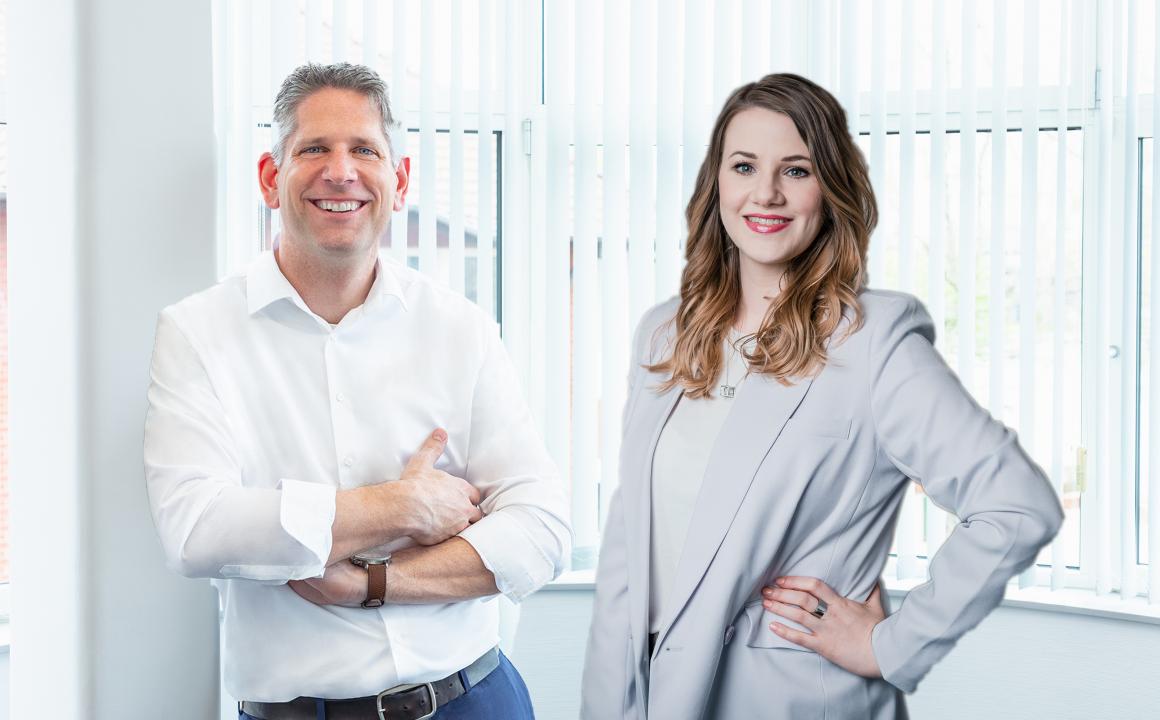
Today, Tabea Gumrich talks to one of the founders of brajuu, Melanie Wagenfort, and the lead investor in the financing round, Ingo Hoff. In this interview portrait, Tabea wants to know how the two found each other, what it means to be a lead investor, and what is important for a good investor-startup relationship.
It's great to have you here today! Ingo, let's start with you. Tell us a little bit about who you are and what you do.
Ingo: I am very fortunate to be the second generation to run Hoff und Partner, which I consider to be the best and coolest planning office in Germany. I'm interested in digital things, even though I've never written a line of code myself. But I have great admiration for all people who take their entrepreneurial activities into their own hands, and I would like to promote entrepreneurship accordingly.
So you've basically already answered the question of how you became a business angel - out of interest, right?
Ingo: Yes, with the great fortune of having my own family business behind me. We were looking for opportunities not only to invest money, but also to go beyond that and support with knowledge or networking.
In which areas are you invested? You said that you are interested in digital topics – is there an industry you focus on?
Ingo: Both are important to me: I want to make a difference, and not so much as a patron with donations, but in a way that is also profitable. At the same time, I want my positive returns to give me the opportunity to create added value. That's why it's also about “impact,” which is very subjective, so I don't have any industry or technology focus. I want to improve and change the world a little bit, so I look for sustainable business models, although here too, the interpretation is very subjective and not based on criteria. This is also reflected very well in the five startups we have invested in as a family business.
I want to make a difference, and not just as a patron with donations, but in a way that is also profitable. At the same time, I want my positive returns to give me the opportunity to create added value.
Which five startups are they?
Ingo: First, there's zmyle. I was particularly impressed by the two founders. We've also invested in Blu Analytics, which is a very exciting startup that uses machine learning, another important topic for the future. Then we have shares in Baukobox, a website for construction details - so we've actually invested in the construction industry too! Startup number four is Agriportance: this is about eco-balancing, or CO2 certificates, and thus sustainability. And now we have also invested in Brajuu and thus in Melanie. Here, too, I see the sustainability approach, namely being able to help 50% of humanity and not just having a chic fashion item.
That brings us to the keyword: Brajuu. Melanie, what do you do at Brajuu and how did you and Ingo find each other?
Melanie: Brajuu is the marketplace for perfectly fitting underwear. We have developed a technology that makes it easy for women to find bras that fit their bodies perfectly online. We also use machine learning for implementation and are currently focusing on reaching end customers and helping them find perfectly fitting underwear, which can then be purchased directly from us. This means that we are a hybrid of a software company and a marketplace/e-commerce platform in the fashion tech sector.
You recently completed your first fundraising round. How did that happen and how did you meet Ingo?
Melanie: After the bootstrap start, we realized that things were going quite well, but also that we needed follow-up financing in order to really grow. So at the end of 2020, we started looking for various investors, did a lot of pitching, and had many conversations - some good, some bad. In January, we participated in a matchmaking evening organized by the Business Angel Netzwerk of Digital Hub münsterLAND - the Angel Talk. The introduction came directly from Digital Hub Aachen to Digital Hub münsterLAND, so we were able to pitch. Ingo was in the audience - around 40 angels were there. Immediately after the pitch, we talked to Ingo for over an hour, and it became clear relatively quickly that we would come together. At that point, we already had three other commitments. We were just looking for one last person to close the round.
After the bootstrap launch, we realized that things were going quite well, but also that we needed follow-up financing in order to grow properly and reach a large number of people with our service.
Ingo, what convinced you or what sparked your interest at first glance?
Ingo: There were two things: One is that I see the Digital Hub as the go-to place for digitalization in all industries. The second is that I have already participated in various pitch events, among other things to prevent my own operational blindness. So I'm not always looking for a way to get rid of money, but rather for a way to gain more knowledge, which has worked very well so far. I wasn't looking for anything that evening, but I was completely open to a topic that I would otherwise be less familiar with.
The pitch, the presentation, the person - in this case, Melanie - was better than many I have heard before. This led me to think: I need to get to know this person and their approach.
Thanks to further support - I realized myself that in this particular case, I am more of a “money man” - I was glad that I wasn't the only investor and that the angels' expertise complemented each other, and it is precisely this mix that is the strength of what we at Brajuu have to offer.
Are there any classic questions you ask or areas you focus on when considering potential investments, i.e., startups?
Ingo: My gut feeling and trust in the founders are important, as there will always be questions and situations that I don't see coming and that no one knows about. So I ask myself whether I trust the person to solve the problems and challenges that will inevitably arise. If I were to decide alone, this would probably be my only criterion. But I now have two or three good friends who support me, are also socially connected to me, and put potential investments to the test. In doing so, we also try to analyze the business model as objectively as possible in terms of its value creation and, of course, its financial and marketing plan.
To put it another way, how did you choose your business angels and what was important to you, Melanie?
Melanie: In addition to gut feeling, the investors' vision for the future of the company must also be right. You are giving up part of your company and thus also part of your say in how it is run, so you need to be sure that your values are the same or at least very similar, otherwise you won't be able to develop a shared vision and strategy for implementation, because conflicts will arise. We also spoke to people who said that the company would have to turn a profit very quickly, which would have been at the expense of growth. However, since we are growing rapidly and only want to become profitable later, that would be something that would cause stress. It was also important to us to find angels who would support us and accompany us in a mentor-like relationship, whom we could ask for advice, but to whom we would not have to send reports every other day or who would not restrict our freedom to make decisions. In this process, with our own criteria and a specific use case and product, the circle of target individuals becomes very small. It has also happened that we have rejected candidates or broken off discussions because we realized that the values did not match.
We would rather search for another two or three months than hand over part of our company to people we know we won't get along with.
Ingo: If I may, I would like to add to that. Startups and founders have their homework to do, but I find the self-confidence that Melanie exudes here impressive - that startups and business angels meet on equal terms and venture capitalists should not act as controllers, but rather as supporters, perhaps even as accelerators. And I consider that to be much more important: not to steal time from your startup, especially if you are already invested in the company as an investor. Then I should do everything I can to increase the value of the shares. That's why we prefer to support and only require, for example, the reporting that the startup itself must have, because a startup without its own controlling is crazy. But even then, an extract or a summary is usually sufficient.
Melanie, I gather that you went into the discussions with complete openness and also stated how you envisioned this relationship. Is that correct?
Melanie: Yes, of course you're in a situation where you want money and you want to get into networks through angels, but we also have something to offer. I think if you don't approach it with this attitude and feel like a supplicant, then you will convey that feeling and may not get the best deal or end up with people at the cap table who have other motives.
Were there any moments or red flags that you had to discuss at length?
Ingo: In this particular case, we were very fortunate that Brajuu and Melanie had done a lot of groundwork, including discussions that had already taken place. As a result, we had a very good and clear basis for making a decision. I usually say no more often than yes, but fortunately that wasn't necessary here because the package presented was just so good. So there were only minor things that needed to be discussed.
Melanie: I sent over the business plan and the term sheet at the time, and a week later you said, “Yeah, that works!” There were a few more questions, but nothing earth-shattering. The whole process actually took a little longer because we re-established Brajuu GmbH and there were still some legal and tax issues and challenges to deal with.
What are the motivations of the other investors and business angels?
Melanie: They all come from different fields, which is good because it means they all bring different perspectives and networks to the table. I got to know some of the investors through events and through the network of another accelerator program we did before.
Ingo, you are the lead investor in this round. What does it mean to lead a round as a lead investor?
Ingo: Not much for me. What was important to me was that we complement each other as investors when I get involved with a product and technology that I can't help much with. Of course, I also serve as a sparring partner or help with networking. The person who puts in a few more euros gets a few more percent, but that only matters when we talk about dividends or the sale. So we don't make any distinctions. No investor is more important or better than another; we see ourselves as joint investors.
Is there a separate exchange between you as investors?
Ingo: Of course, we have each other's contact details, but the common ground so far is Brajuu, or rather Melanie, and the current focus is clearly on how we can contribute to its success. That's why we don't need to coordinate with each other at the moment, which would of course be different if we were acting and investing jointly from the outset. Then it would be easier for the founders if there were only one contact person. It's important, and I'm very happy about this, that we as investors all have a good and trusting relationship with each other. That's why I'm open to considering further joint ideas for the future.
What does your collaboration look like now that the round has been completed? Has a 100-day plan been agreed upon?
Melanie: No. There was a concrete business plan in advance that not only described the status quo, but also showed in relative detail how we would use and spend the planned money. Therefore, we “only” had to implement it, closed the round 6-8 weeks ago and started. In our roles as managing directors, we hold more or less regular shareholder meetings to get approval for certain decisions and to seek advice. I don't think it would be good if our investors didn't know what we were thinking about, what was going well and what wasn't, so we are very open about this. We would rather communicate too much than keep things hidden behind a veil of secrecy.
Ingo: Especially in the early stages, I prefer to take a little time regularly to get a feel for current developments. That way, I can be a better discussion partner when decisions need to be made. And, of course, this doesn't just apply to my own investments; it's also very important for young or small companies to be able to talk to someone. That could be the investor or, for example, the Digital Hub. I think it's important to remember that, in the end, it's good for everyone to step outside their own bubble a little. That's why I'm convinced that this regular exchange is also beneficial.
Of course, we're also very interested in what you're going to do with the money invested in you, Melanie. Do you want to hire more staff? What are your plans for the future?
Melanie: Exactly. In principle, a large portion of the money also goes toward further developing the technology, because that is, of course, our unique selling point, and we want to become even better at it. We also have a fairly substantial marketing budget so that we can talk about it and make people aware that we have developed a great product. And the rest goes to personnel.
Melanie, you recently moved to Münster, didn't you? How do you rate the startup ecosystem in Münster, also in comparison to Aachen, where you were based before?
Melanie: That's an interesting question, but unfortunately I can't say much about that yet, as I've only been in Münster for a few weeks.
Ingo: If I may add something - what makes me happy, of course with a wink, is that Melanie is from the Münsterland region and originally comes from a district of Borken. After all, you have to remember that Münster is synonymous with the entire surrounding area and there is good cooperation between the regions. As I see it, a lot has happened in Münster in terms of promoting startups over the last few years. And, in that regard, I hope we haven't reached the end yet. We should now also be appearing on the startup map, which I am very pleased about. What sets us apart in the Münsterland region and, above all, promotes networking is that we also have a few satellite locations. After all, there are also many established companies that have not found a location in Münster or do not come directly from Münster.
As I see it, a lot has happened in Münster over the last few years in terms of promoting startups. And, as far as that goes, hopefully we haven't reached the end of the road yet.
Do you have any final advice for a good investor-startup relationship?
Melanie: My advice would be to be clear about who or what you are looking for and not to make any major compromises. You need to have a list of criteria for what is important in the people you invest in, what attitudes and values they should have, and you shouldn't waver from that just because you could close a fundraising round a little faster with someone else. It's also important to keep an eye on the big picture, not just the money. Of course, that's advice from a position of luxury; sometimes you just have to do a quick round because otherwise the company will die.
You need to have your own list of criteria for what is important in the people you invest in, what attitudes and values they should have, and you shouldn't compromise on that just because you could get a financing round done a little faster with someone else somewhere else.
Ingo: I agree wholeheartedly, with one addition: once you've clarified this, you should also be smart enough to consider where to meet your counterpart halfway. That's something I find lacking in some areas outside of this investment. I often don't get the feeling that my counterpart has thought about where to meet me halfway. But when I'm bombarded with information, or don't get any information at all, I find it very difficult. That's one reason why I don't want to give people a checklist to work through right away. I'm simply very interested in how empathetic the other side is and whether they have thought about what my counterpart wants. Because only then do you have a match on equal terms, which is fun.