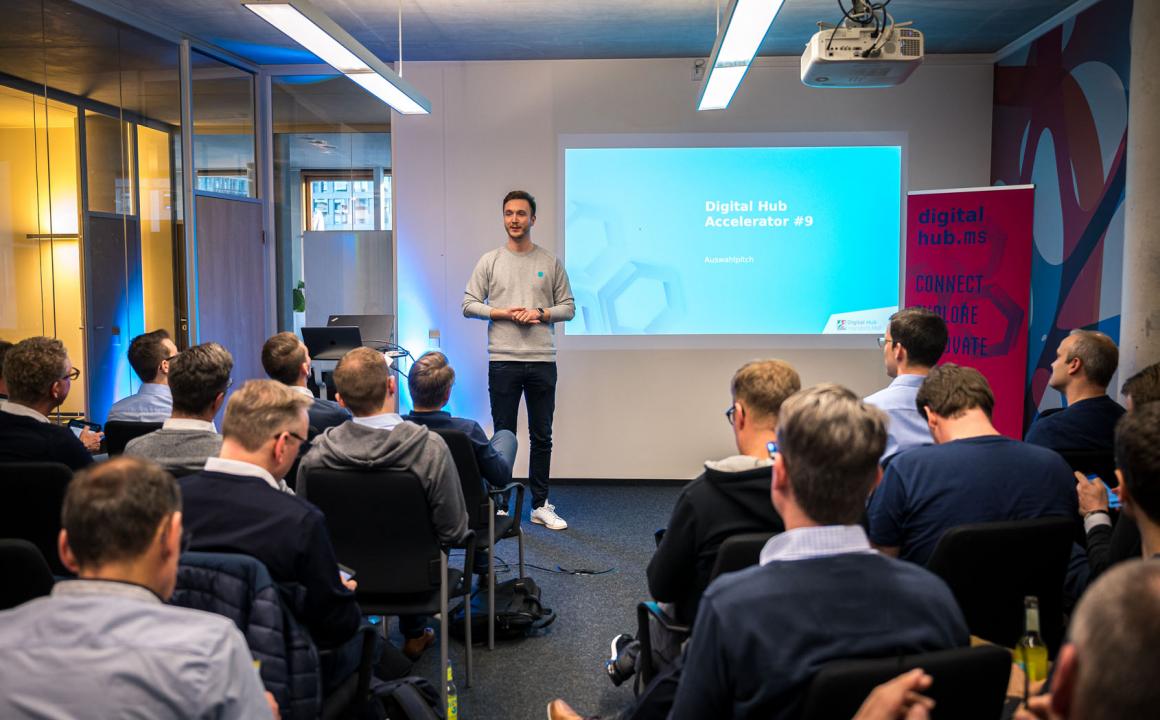
The Digital Hub Accelerator was launched in 2017 and supports startups from the Münsterland region in finding their product-market fit. Thirty-six teams have completed the program so far. Time for a brief review.
One of our first steps after founding our association in 2017 was to launch the Digital Hub Accelerator. Without much experience, we simply put out a call and wondered if anyone would apply. We were delighted and surprised when we finally sat down with a handful of experts for the selection pitch and were able to choose two startups for the first batch.
We have always focused on helping them find their product-market fit - the crucial question for every startup. This milestone marks the transition from the search for the right product to the growth or scaling phase. Achieving it is the central task of founders, but one that many fail at. With the establishment of the REACH Euregio-Start-up Center and the resulting significant expansion of startup support in the early founding stages, this focus has become even more pronounced in our program. Our aim is to accompany startups through the scaling phase, right up to the first major institutional financing round and the possible application for the Scale-Up.NRW program.
In such a phase, startup support can no longer follow a standard formula, but requires individual and specific support for each startup. Our response to this is a highly individualized accelerator program, which we tailor as closely as possible to each startup. Ideally, the startups won't have time to deal with us anyway. What sounds paradoxical at first is ultimately only the logical consequence of the challenges of this development phase. We want our teams to be with the customer, constantly working on the product and diligently establishing contacts with business angels. Ideally, there are now only a few hours per week left for additional input from us - and these must be well prepared, presented in a perfectly tailored manner and thus create additional value for the founders.
One focus is naturally on establishing exciting contacts for the startups in our network of companies and investors - with the clear expectation that an “introduction” should be more than a simple exchange of email addresses. Instead, it is important to assess in advance whether a collaboration makes sense by thoroughly understanding the needs of both sides. Only then do we confidently recommend entering into direct contact. In almost all cases, our initial contact leads to more in-depth discussions and, perhaps later, to concrete collaborations and investments. Our network of experts plays a decisive role in this process. In this network, which we curate, we unite innovation managers from our member companies and proactively connect them with startups. This results in a variety of closer connections between individuals, companies, and startups.
Another important component of the Digital Hub Accelerator is the high-profile presentation of the startups. This is achieved on the one hand through our own events such as the Accelerator Demoday and the Digital Summit Euregio. On the other hand, we place startups on the national stage in a targeted manner via our extensive network in North Rhine-Westphalia, e.g. with the DWNRW Startup of the Month. At the latest during the scaling phase, most startups are no longer working quietly behind closed doors. When it comes to attracting partners and employees, a certain level of name recognition and differentiation as a successful, scalable startup from the broad mass of founders is essential.
In total, accelerator startups have raised approximately EUR 25 million in external capital and currently employ around 350 people (as of November 2022).
To date, we have supported a total of 36 startups in 15 rounds (as of November 2022). We have received over 150 applications. From this selection rate of just over 20 percent, we also conclude that the digital startups in the program are those with the highest development potential in the region. Some interesting facts about the Accelerator startups can be summarized:
- 61% of the teams were in employment immediately prior to founding their company. 31% founded their company directly after completing their university/college education.
- Looking at the most recent place of study before founding the company, the University of Münster (42%) and the University of Applied Sciences Münster (22%) are most strongly represented in the founding teams.
- 81% of the teams have their headquarters in Münster, while 19% are located elsewhere in the Münsterland region.
- Of the 36 teams, 31 are still active. All teams that have participated in the program since 2019 are still on the market.
- In total, our accelerator startups have raised approximately EUR 25 million in external capital and currently employ around 350 people.
- 22% of the teams have a female founder as a partner, while 78% are all-male teams (this distribution is similar to the Germany-wide level for technology-oriented startup teams).
All regions in Germany now offer extensive support for early-stage startups, primarily through transfer institutions at universities/colleges, chambers of commerce, and business development agencies. Support for startups in the scaling phase is less common and also more difficult to organize. As described above, the support offered must be tailored and specific, with high demands on flexibility, the size of the network, and the expertise of the people involved. In addition to our team's experience with digital business models and business development, we therefore always incorporate tailored expertise from our community into our startup exchanges.
If a startup loses its connection to its founding location during the scaling phase, there is a greater likelihood that it will outsource large parts of its business operations or even relocate the entire company to the startup hotspots of major metropolitan areas. Even if the connection with the home location is not completely lost, the positive economic effects (especially the creation of jobs in future-oriented industries) will then mostly occur in other regions. It is therefore worthwhile to work towards ensuring that startups from the Münsterland region achieve product-market fit and then embark on a strong growth path in their home region.